
Shipping guide · Asia Pacific
Shipping from China and Hong Kong to New Zealand
New Zealand applies some of the strictest biosecurity requirements in the world, and they are the deciding factor in most imports. Customs itself is efficient and duty is often zero under the free trade agreement with China.
- Customs authority
- New Zealand Customs Service, with MPI for biosecurity
- Defining requirement
- MPI biosecurity clearance, frequently more decisive than customs
- Trade agreement
- China New Zealand FTA, with duty-free entry for most qualifying goods
- GST
- 15 percent, applied at import and recoverable by registered businesses
- Seasonal measure
- Stink bug season requirements apply to target goods and countries
- Main entry points
- Auckland and Tauranga by sea, Auckland by air
The Ministry for Primary Industries assesses risk on goods, packaging and containers, and it has the authority to require treatment, direct re-export or order destruction. This is not a formality applied loosely: New Zealand agricultural exports depend on its pest and disease status, and the enforcement reflects that.
The China New Zealand free trade agreement, in force since 2008, means most qualifying Chinese origin goods enter duty free with a valid certificate of origin. Combined with a simple 15 percent GST, the fiscal side of an import is uncomplicated.
Geographically the country is served mainly through Auckland and Tauranga in the north, with Lyttelton serving the South Island. Distances are modest by Australian standards, but the two islands still need to be thought about separately.
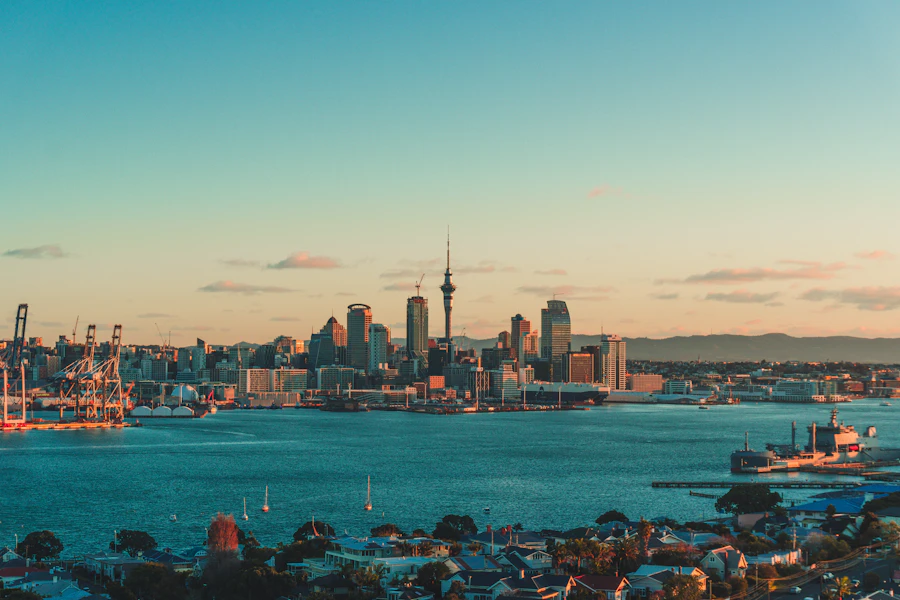
Where cargo lands
Main freight and distribution centres
Auckland
The dominant market, with the main port and airport and most national distribution.
Tauranga
The largest port by volume, serving the north island with good inland connections.
Wellington
The capital, at the bottom of the north island, and the link point between the two islands.
Christchurch
The main south island market, served by Lyttelton port and its own airport.
Sea freight
Ports of entry and what they mean for your cargo
Tauranga
The largest New Zealand port by volume, handling a substantial share of container traffic with good road and rail links.
Auckland
Serves the largest market directly, in the city itself, with the shortest final leg for Auckland destinations.
Lyttelton
The south island gateway, serving Christchurch and the surrounding region.
Napier and Nelson
Regional ports serving their own hinterlands, mainly export oriented but usable for imports.
Most Asian cargo arrives via a transhipment, commonly in Singapore, Malaysia or Australia, so the routing has two legs and the connection matters.
Tauranga and Auckland both serve the north island well, and the choice usually depends on the service and the final delivery point rather than a structural difference.
Cargo for the south island is better landed at Lyttelton than trucked and ferried from the north, where the volume justifies it.
Air freight
Airports and when air is the right answer
Auckland (AKL)
The main air cargo gateway with full customs and biosecurity facilities.
Christchurch (CHC)
The south island gateway, with its own cargo handling.
Air freight from Asia arrives via a hub, so transit is longer than for a direct market, but frequency is adequate for urgent cargo.
Biosecurity applies to air cargo exactly as to sea cargo, and inspection at the airport can add days regardless of how fast the flight was.
Indicative transit times
How long the movement usually takes
- Sea FCL, South China to Auckland or TaurangaAround 18 to 28 days port to portUsually with a transhipment, which is where the variability comes from.
- Sea LCL, South China to New ZealandAround 26 to 38 days door to doorConsolidation, transhipment and biosecurity all add time.
- Air freight, Hong Kong or South China to AucklandAround 4 to 8 days door to doorVia a hub, including handling, biosecurity and clearance.
- Biosecurity inspectionAdd 1 to 7 days where selectedIndependent of customs clearance and a genuine planning variable.
These ranges are indicative and exist to help you plan. Real transit time depends on the service, the season, the routing and the clearance itself, and we confirm it per shipment rather than publish it as a promise.
Customs
How clearance into New Zealand actually works
The competent authority is New Zealand Customs Service, with the Ministry for Primary Industries.
MPI biosecurity clearance is separate from customs clearance and often the binding constraint. Goods, packaging, containers and any organic contamination are all assessed, and treatment or re-export can be ordered.
The China New Zealand free trade agreement provides duty-free entry for most qualifying Chinese origin goods with a valid certificate of origin, so duty is frequently not a factor when the documentation is correct.
GST at 15 percent applies to imports and is recoverable by registered businesses through their returns.
New Zealand Customs is efficient and communicates clearly, and the administrative burden is light compared with most markets in this list.
A foreign company can import but needs a New Zealand entity or an arrangement with a local importer, and GST registration where relevant.
Documentation
What you need to have ready
Commercial invoice
Value, terms and a clear description consistent with the transport document.
Packing list
Piece counts, weights and dimensions per package.
Bill of Lading or Air Waybill
The transport contract and the release instrument.
Certificate of origin
Under the China New Zealand FTA to claim duty-free entry.
Packing declaration
Describing packing materials, required for biosecurity assessment.
Treatment certificate
For fumigation or heat treatment where required, including seasonal measures.
ISPM 15 compliant wood packaging
Enforced strictly, with treatment or re-export the consequence of non compliance.
Import health standard documentation
For goods covered by a specific MPI import health standard.
Controlled and restricted goods
What gets stopped, and why
- Biosecurity is the strictest element of importing into New Zealand. Soil, seeds, insects, plant material and untreated timber all create serious problems.
- Seasonal stink bug measures apply to defined goods and countries during the risk season, requiring treatment.
- Used machinery and vehicles must be cleaned to a standard that removes all soil and organic material, and this is inspected.
- Food and agricultural products require compliance with specific import health standards.
- Electrical goods must meet New Zealand safety requirements, which are aligned with Australian standards in most areas.
- Wood packaging must comply with ISPM 15 without exception.
Working with Velonex
What clients usually bring us in for on this lane
- Planning biosecurity compliance before loading, since container condition and packing declarations determine what happens on arrival.
- Used machinery and equipment, where the cleaning standard required is far higher than most exporters expect.
- Using the China New Zealand FTA properly so qualifying goods enter duty free rather than paying because of a documentation error.
- Managing the transhipment leg, which is where most schedule variability on this lane comes from.
- Cargo for the south island, landed at Lyttelton rather than moved down from Auckland where volume allows.
Get a quote
Tell us what needs to move to New Zealand
We listen before we quote. Share the cargo, the deadline and the constraint, and we will come back with a route that accounts for all three, the documents it will need and a timeline we can stand behind.
Your details
Includes your name, company name and email address
Shipment route
Includes your pickup location and destination
Cargo type
Includes the type of cargo you are shipping
Special requirements
Includes a short note about your challenge
Timeline
Includes your desired timeline
Your quote
A tailored response based on everything above

Corporate logistics partner
Trust, clarity and operational follow through for complex cargo.
Not ready for a quote? Email info@velonex-hk.com or message us on WhatsApp with the question and we will answer it.
Sources
Where this information comes from
- New Zealand Customs Service
- Ministry for Primary Industries, importing
- MPI import health standards
- Port of Tauranga
General guidance, last reviewed August 2026. Customs rules and product requirements change, and the treatment of any specific shipment depends on its classification, origin and value. Confirm the detail with us or with the authority before you commit to a movement.
More in this region
Other guides for Asia Pacific
- AustraliaSydney Opera House
- BangladeshRiver through Dhaka
- IndiaGateway of India, Mumbai
- IndonesiaSelamat Datang Monument, Jakarta
- JapanShibuya crossing, Tokyo
- MalaysiaPetronas Towers, Kuala Lumpur
- PhilippinesManila skyline
- SingaporeMarina Bay, Singapore
- South KoreaNamsan Tower, Seoul
- Sri LankaLotus Tower, Colombo
- TaiwanTaipei 101
- ThailandTemples in Bangkok
- VietnamHo Chi Minh City skyline
See all 51 country guides, or tell us the destination you need and we will walk you through it.