Industry Insights · September 2026
Shanghai and Ningbo are backed up, and ships are skipping the call
Average waits of 5.46 days at Shanghai and yard occupancy of 92 to 95 percent at Ningbo, after typhoon closures. Some carriers are now skipping the call rather than queueing.
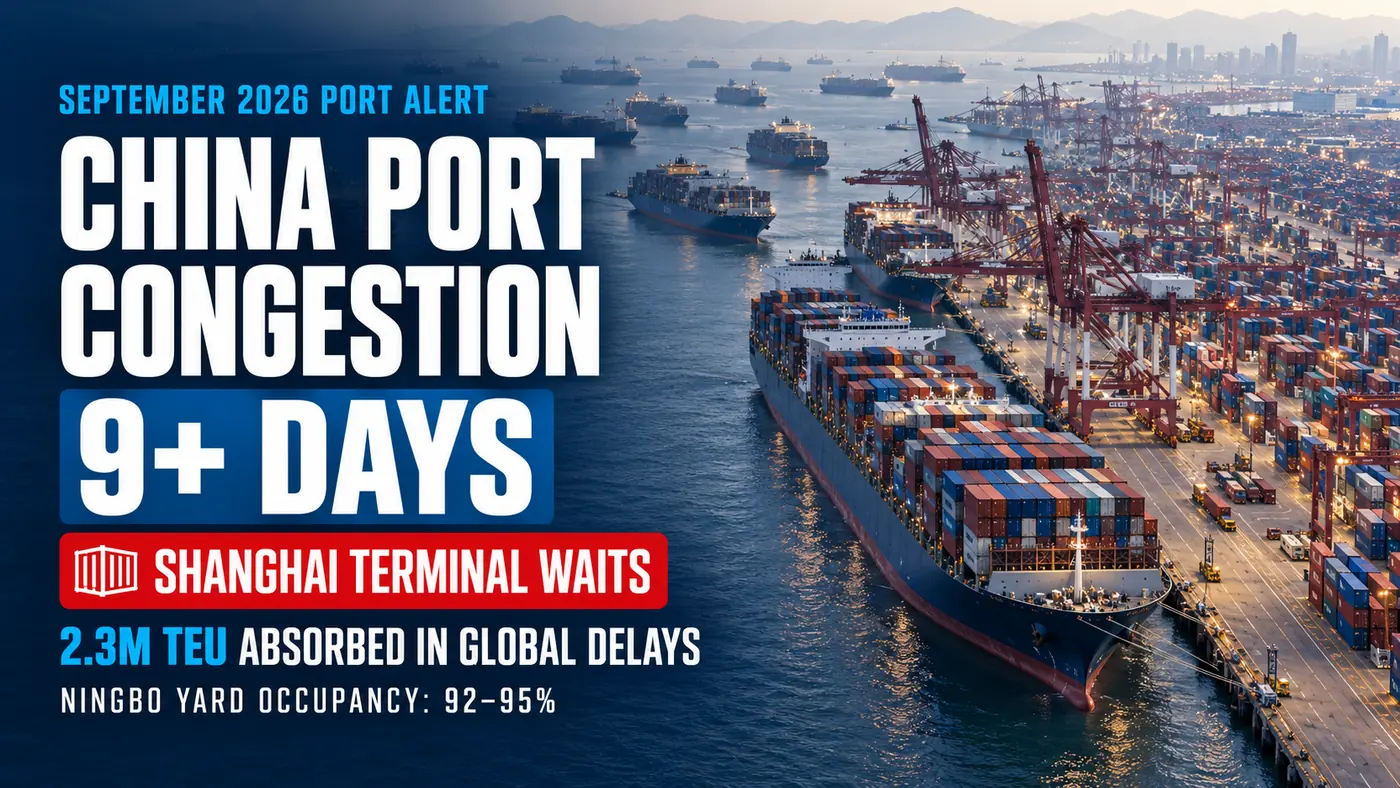
Two of the largest export ports in the world are running behind. As of 4 September, vessels at Shanghai were waiting an average of 5.46 days to berth, with individual terminals running past nine days, and 99 ships sitting at anchorage against 42 at berth. At Ningbo on 1 September the seven day average wait was 3.45 days, with yard occupancy running at 92 to 95 percent, according to reporting compiled by Kuehne+Nagel.
The trigger was weather. Typhoon closures took Ningbo out for 78 hours and Shanghai terminals for between 48 and 54 hours. A port does not restart at full speed after that: the vessels that could not berth arrive together with the ones that were already scheduled, and the yard fills up before the queue clears.
The part that matters operationally is what carriers are doing about it. Rather than wait, some are omitting the call. Kuehne+Nagel reports the OOCL Lilac skipping Shanghai and routing to New York via the Indian Ocean on a roughly 30 day transit, and the CMA CGM Leo rerouting through Suez to reach Norfolk. Sea-Intelligence puts the global figure at 2.3 million TEU absorbed in delays and 6.6 percent of the fleet effectively unavailable.
That last number is why this is not only a China problem. Capacity tied up waiting off Shanghai is capacity that is not serving a lane somewhere else, and space tightens on routes that look untouched by any of this.
What it means for your cargo
The part that changes a decision
An omitted call is not a delay, it is a different plan
If a vessel skips your load port, your container does not arrive late, it does not go at all. It waits for the next available sailing, which may be a different service with a different transit and a different destination terminal. Ask your forwarder what happens to your box in that case, before it happens.
Watch yard occupancy, not just vessel waiting time
Ningbo at 92 to 95 percent occupancy is the number that decides whether you can gate in at all. Waiting time tells you when a ship berths; occupancy tells you whether your container can even reach the terminal to make it. They fail at different points in the chain.
Book earlier than the transit time suggests
With 6.6 percent of the fleet absorbed in congestion, the constraint is space rather than sailing days. Cargo with a fixed delivery date, a retail opening or a project milestone should be committed further ahead than a normal month would require, and the decision belongs at the purchase order rather than at the port.
Get a quote
Apply this to a real shipment
Conditions only matter once they hit a specific lane, a specific deadline and a specific cargo. Tell us yours and we will tell you what it changes.
Your details
Includes your name, company name and email address
Shipment route
Includes your pickup location and destination
Cargo type
Includes the type of cargo you are shipping
Special requirements
Includes a short note about your challenge
Timeline
Includes your desired timeline
Your quote
A tailored response based on everything above

Corporate logistics partner
Trust, clarity and operational follow through for complex cargo.
Sources
Where the figures come from
- China port congestion forces carriers to adjust schedules · Kuehne+Nagel
- Global capacity absorbed in port delays · Sea-Intelligence
Market commentary, last reviewed September 2026. Rates, capacity and routing move quickly, and none of the above is a quotation. Confirm the position with us before you commit to a movement.